
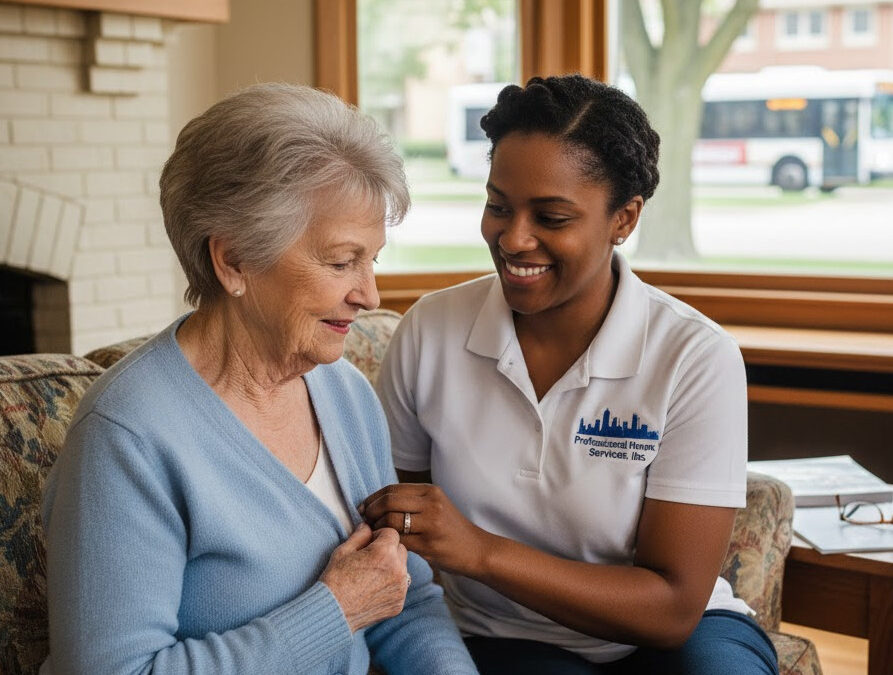


If you’re exploring healthcare careers in the Milwaukee area, you’ve likely seen openings for a Personal Care Worker, or PCW. It’s one of the fastest-growing and most essential roles in our community. But what does a PCW really do? What is the job actually like, day-to-day?
Here at Professional Home Care Services, Inc., we believe in transparency. We’re a dedicated Milwaukee-based agency, and we want our team to love their work. That starts with prospective caregivers understanding the full picture before they even apply.
This isn’t just a job description. This is an honest look at the realities, challenges, and incredible rewards of being a home health PCW.
What is a Personal Care Worker (PCW)?
A PCW is a non-medical healthcare professional who helps clients—often seniors or individuals with disabilities—live safely and with dignity in their own homes. You are the hands-on support that makes independence possible.
Your core mission is to assist clients with “Activities of Daily Living” (ADLs). A typical day might include:
- Personal Hygiene: Assisting with bathing, dressing, grooming, and toileting.
- Mobility Support: Helping clients move safely around their homes, transferring from a bed to a wheelchair, or going for a walk.
- Meal Preparation: Cooking nutritious meals and helping with feeding if necessary.
- Light Housekeeping: Tidying up, washing dishes, doing laundry, and changing bed linens.
- Errands & Transport: Driving clients to doctor’s appointments, picking up prescriptions, or grocery shopping.
- Companionship: This is the big one. You are often a client’s main source of social interaction. Talking, playing cards, or just watching TV together is a vital part of the job.
- Medication Reminders: Ensuring clients take their pre-sorted medications at the right time.
The Unconventional Schedule: A Day in the Life of a PCW
This is one of the most important things to understand: a home health PCW job is not a typical 9-to-5, eight-hour shift at one location.
Our clients at Professional Home Care Services need help at specific times of the day. One client may need two hours of help in the morning to get bathed, dressed, and eat breakfast. Another may only need one hour in the afternoon for lunch and light housekeeping. A third client might need three hours in the evening for a meal and help getting ready for bed.
A PCW’s daily schedule involves driving to one client’s home, working for 1-3 hours, and then moving on to the next client’s home.
This type of schedule has its own set of pros and cons.
- Positive Aspects of the Schedule:
- Incredible Flexibility: This schedule is ideal for students, parents who need to be home for their kids, or anyone balancing other life commitments.
- Variety: You are not stuck in one building all day. You get a change of scenery, meet different people, and perform different tasks, which keeps the day from becoming monotonous.
- Autonomy: You are in charge of managing your time between clients, giving you a strong sense of independence.
- Negative Aspects of the Schedule:
- Travel Time: You will be driving between clients. You must have a reliable vehicle and be comfortable driving in all Milwaukee weather.
- Schedule Gaps: You might have a client from 9-11 AM and your next one isn’t until 1 PM. You have to be good at managing these “unpaid” gaps in your day.
- Less Predictability: A client may cancel or an appointment may run long, requiring you to be adaptable. It’s not the rigid, predictable structure of an office job.
The Honest Truth: The Challenges of a PCW Job
We value honesty. This job is not for everyone. It’s important to know the challenges upfront.
- It is Physically Demanding: You will be on your feet, bending, lifting, and helping to support the weight of other adults. Proper body mechanics are crucial.
- It is Emotionally Taxing: You will build relationships with clients who are aging, ill, or facing cognitive decline. You will witness their struggles and must be a source of strength while managing your own emotions.
- It Requires Patience & Boundaries: You will encounter diverse personalities, family dynamics, and sometimes challenging behaviors. Maintaining a professional, patient, and compassionate boundary is a skill you must learn.
- It Requires Unwavering Reliability: A client is depending on you to show up. If you don’t arrive, they may not eat, get out of bed, or get their medication. You must be exceptionally reliable.
The Real Rewards: The Moments That Make It All Worthwhile
So, why do our PCWs at Professional Home Care Services love what they do? Because the “pros” aren’t just about a flexible schedule—they are about making a profound, tangible difference.
Here are a few real-world examples our caregivers have shared:
- The Stroke Survivor’s Comeback: A PCW was assigned to a client in his 70s who was recovering from a stroke. He was deeply depressed, convinced he’d never cook for himself again. His PCW, “Sarah,” learned his favorite simple recipe (scrambled eggs) and patiently worked with him every morning—first just holding the spatula, then stirring, then cracking the eggs. After three weeks, he made his own breakfast. “He cried, and I cried,” Sarah told us. “I didn’t just make him a meal; I helped him get a piece of his life back.”
- The Forgotten Hobby: “James,” a PCW, was with a client who was quiet and withdrawn. Her family mentioned she used to love painting. James brought a small, simple watercolor set on his next visit. At first, she just watched. Then, she started mixing colors. Now, they spend an hour every visit painting together. Her whole demeanor has changed. “Seeing her smile and talk about the colors is the best part of my week,” James said. “It’s a connection, not just a task.”
- The Life-Saving Observation: A PCW, “Maria,” arrived at a client’s home and just felt “something was off.” The client was more confused than usual and her breathing seemed shallow. Instead of ignoring it, Maria immediately followed protocol, checked her vitals, and called our on-call nurse. The client was in the early stages of pneumonia. Because Maria caught it early, the client was treated and made a full recovery. The client’s family was eternally grateful. “They told me I saved her life,” Maria said. “That’s not just a job. That’s a purpose.”
Are You Ready to Make a Difference in Milwaukee?
Being a PCW is a calling. It requires a unique blend of compassion, patience, reliability, and grit. You are the backbone of home health care, the person who allows our Milwaukee neighbors to stay where they are most comfortable: at home.
At Professional Home Care Services, Inc., we don’t just see you as an employee; we see you as a vital member of our team and the community. We provide the training and support you need to succeed.
If you read this article—the good and the bad—and felt a spark of “I can do that,” then we want to hear from you.
This is your chance to do work that matters.
To learn more about our open caregiver and PCW positions in the Milwaukee area, please visit our jobs page today: https://www.phcsonline.com/blog1/home-care-jobs/
Useful External Resources for Aspiring PCWs:
National Association for Home Care & Hospice (NAHC): Get a broader sense of the home care industry and its importance.
Link: NAHC – Home Page open PCW positions and training programs.
PHI (Paraprofessional Healthcare Institute): A national organization dedicated to strengthening the direct-care workforce. They have excellent resources on the role of caregivers.


Recent Comments