



For individuals living with quadriplegia, navigating daily life involves managing a variety of complex health needs. At Professional Home Care Services, Inc., we provide premier Milwaukee home health care. Therefore, we deeply understand that one of the most critical—and frequently misunderstood—daily needs is a specialized bowel routine.
Let’s be straightforward about this topic. While a bowel routine isn’t typical “polite” dinner conversation, ignoring it is incredibly dangerous. In fact, a consistent, effective bowel management program is a fundamental cornerstone of health for anyone living with a high-level spinal cord injury.
We created this comprehensive guide for our clients, their supportive families, and our dedicated Personal Care Workers (PCWs). Below, we will explain exactly why this routine is a medical necessity. Furthermore, we will detail how our expert providers of personal care services assist, and we will highlight why we must eliminate all stigma surrounding this life-sustaining procedure.
Why is a Bowel Routine a Medical Necessity?
When an individual experiences a spinal cord injury at the cervical (neck) level, it typically results in quadriplegia. This condition involves paralysis that affects all four limbs. Additionally, this severe injury interrupts the essential nerve signals traveling between the brain and the digestive system.
Medical professionals call this specific condition neurogenic bowel.
Because of this nerve interruption, the muscles that control regular bowel movements no longer function voluntarily. Consequently, the brain cannot “tell” the body it is time to go to the bathroom. Similarly, the body cannot “tell” the brain that the bowel is full. Without a carefully managed, daily routine, this disconnect leads to severe, life-threatening complications, including:
- Constipation and Impaction: Stool builds up continuously and can quickly become a severe medical emergency requiring hospitalization.
- Bowel Incontinence: Unpredictable accidents occur, which are a source of significant emotional stress and can cause dangerous skin breakdowns or bedsores.
- Autonomic Dysreflexia (AD): This is a critical, life-threatening medical emergency. It happens when the body overreacts to physical stimuli, such as a full bowel. Ultimately, it causes a sudden, dangerous spike in blood pressure that can lead to a stroke if untreated.
For these critical reasons, an individual living with quadriplegia cannot simply “wait” to have a natural bowel movement. Instead, a daily, specifically scheduled bowel program is the necessary medical solution. Furthermore, digital stimulation serves as a vital component of this care.
The PCW’s Role: Delivering Skilled Personal Care Services
At Professional Home Care Services, Inc., we meticulously train our Milwaukee-based PCWs to understand the gravity of their work. They know that managing a bowel routine is a vital medical procedure, rather than simply basic “toileting.”
Providing excellent personal care services requires extensive training, mutual trust, and unwavering professionalism. The primary goal is to establish a safe, predictable schedule. By emptying the bowels at the exact same time each day (or every other day, depending on the client’s personalized care plan), our PCWs successfully prevent severe health complications.
The Importance of Digital Stimulation
Because the client cannot voluntarily push to expel stool, the PCW must actively assist by performing digital stimulation.
During this technique, the PCW uses a properly lubricated, gloved finger to gently stimulate the client’s rectal sphincter. This specific action triggers an automatic reflex within the lower spinal cord. Consequently, the colon contracts naturally and pushes the stool out.
Ultimately, this is not just a basic “helper” task. It is a highly skilled procedure. It requires a solid understanding of human anatomy, excellent client communication, and acute clinical observation.
How to Perform the Bowel Routine: An Expert PCW’s Guide
Our dedicated Milwaukee home health care team is trained to perform this specific procedure with both technical expertise and profound dignity. While every client has highly unique needs, the core procedure always follows strict professional standards.
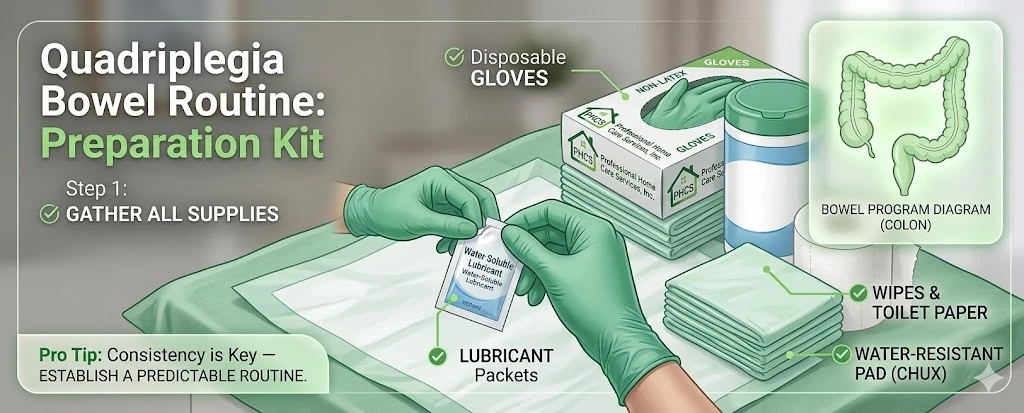
1. Preparation is Key for Success
- Gather all supplies first: Always prepare non-latex gloves, water-soluble lubricant, disposable absorbent pads (chux), toilet paper, hygienic wipes, and a proper waste receptacle before beginning.
- Ensure complete privacy: Close the bedroom or bathroom door. Additionally, make sure the client feels physically warm and emotionally comfortable.
- Proper Positioning: Typically, the PCW positions the client safely on their left side with their knees bent gently upward. Medical professionals call this the Sims’ position. This specific alignment is ideal because it follows the natural anatomical path of the human colon.
2. The Digital Stimulation Procedure
- Maintain Hygiene: First, wash hands thoroughly with soap and warm water, then put on clean, non-latex gloves.
- Apply Lubrication: Apply a generous, comfortable amount of water-soluble lubricant directly to the index finger.
- Perform an Initial Check: Gently insert the lubricated finger to check for any hard stool currently resting in the lower rectum. If stool is present, carefully remove it and place it into the prepared receptacle.
- Begin Stimulation: Re-lubricate the glove and gently insert the finger approximately 1 to 2 inches, pointing carefully toward the client’s tailbone.
- Use the Correct Technique: Next, gently and slowly move the finger in a circular or side-to-side motion. You must maintain continuous contact with the rectal wall. Remember, this is never a “digging” motion. The specific goal is to safely stretch the sphincter and gently stimulate the sensitive nerve endings.
- Monitor Duration: Continue this gentle stimulation for roughly 30 to 60 seconds, or stop as soon as you feel the sphincter actively relax.
- Wait and Repeat: Remove your finger and wait patiently for 5 to 10 minutes for the body’s natural reflex to work. This process—stimulate, wait, produce—is repeated carefully until the bowel is completely empty. Overall, the entire successful program may take between 30 and 60 minutes.
3. Expert Safety Tips for PCWs

- Consistency is everything. You must perform the routine at the exact same time every day to successfully “train” the client’s digestive system.
- Always be patient. This medical procedure is not a race. Rushing can cause physical trauma and makes the routine completely ineffective.
- Communicate continuously. Your client knows their own body better than anyone else does. Talk to them throughout the process. Specifically, ask if they feel any early warning signs of Autonomic Dysreflexia (AD), such as a headache, sudden sweating, or facial flushing.
- Observe carefully. Always pay close attention to the consistency and the total amount of stool produced. This is vital health information that you must document and report to the care team.
- Look out for AD emergencies. If the client suddenly reports a pounding headache, profuse sweating, or facial flushing, stop the procedure immediately. This is likely Autonomic Dysreflexia. Immediately follow the client’s specific emergency protocol (which usually involves sitting them upright immediately to quickly lower their blood pressure).
Positive Experiences: How Expert Milwaukee Home Health Care Changes Lives
Providing this specialized level of personal care services builds incredible, life-lasting trust. Here are three common, anonymized success stories we proudly see among our clients in the Milwaukee area.
The Complete Health Turnaround
One client was suffering from terrifying episodes of Autonomic Dysreflexia twice a week because of an inconsistent, poorly managed bowel program. Fortunately, his new, dedicated PCW established a strict, daily routine. Within just two weeks, the dangerous AD episodes stopped entirely. Consequently, his overall health stabilized, and his frequent, stressful hospital visits were eliminated.
The Return to Confidence and Community
Another client was so profoundly fearful of having a public accident that she completely refused to leave her house. Sadly, this social isolation was devastating to her mental health. However, a reliable PCW who truly mastered her daily routine gave her back the predictability she desperately needed. Today, she regularly attends joyous family events, fully confident that her medical needs are expertly managed.
The Incredible Bond of Trust
A skilled PCW and her client living with quadriplegia have operated as a unified team for over five years. Because of their bond, the daily bowel routine is no longer a source of anxiety. Instead, it is a time of seamless teamwork. The PCW’s unwavering professionalism and the client’s deep trust have transformed a clinical, intimate task into a powerful therapeutic alliance. Therefore, the client can focus his energy on his career and his family, rather than worrying about his bowels.
Conclusion: Health, Dignity, and Expert Personal Care
Ultimately, a highly managed bowel routine for an individual living with quadriplegia is a foundational pillar of their overall health and well-being. It is a strictly necessary medical procedure that successfully prevents life-threatening complications. Furthermore, it provides individuals with a highly predictable, beautifully dignified quality of life.
We firmly believe there should be absolutely no stigma attached to this vital process—no more than there is for a diabetic managing their insulin, or a cardiac patient taking their daily blood pressure medication.
At Professional Home Care Services, Inc., we are deeply proud to provide the most expert, compassionate Milwaukee home health care available. Our PCWs are highly trained professionals who completely understand the critical importance of these life-sustaining daily procedures.
If you or a loved one requires expert personal care services for a spinal cord injury, please contact our Milwaukee office today. We are always here to help you live safely and comfortably.
External Resources for More Information
For further reading on managing neurogenic bowel and living with a spinal cord injury, please visit these highly reputable medical sources:
- The Christopher & Dana Reeve Foundation: Bowel Management Guide
- Shepherd Center: Spinal Cord Injury Bowel Care
- United Spinal Association: Neurogenic Bowel and Digital Stimulation